Hussite wars
Strečno castle was not left unscathed by the various military conflicts which broke out over the centuries in the Kingdom of Hungary. One of these was the Hussite wars. This involved followers of the religious reform movement in Bohemia who began to gather around the reformer Jan Hus. Following on from the ideas of the English scholar John Wycliff, Hus criticised the secular power of the Catholic Church and demanded its return to apostolic poverty. He saw the church as a community of the faithful destined for salvation and living according to God’s law, and designated Jesus Christ as the head of the church, not the Pope. Hus’s opinions came into irreconcilable conflict with the Church’s leaders. He was labelled as a heretic and finally burnt at the stake in 1415. Nevertheless, his teachings continued to be spread in Bohemia. Hus’s followers took communion under both kinds (bread and wine from the cup), and so their symbol became the chalice. The Hussite movement took on a militant form in 1419, when its radical wing defenestrated from Prague Town Hall members of the council and began to pillage churches and monasteries.
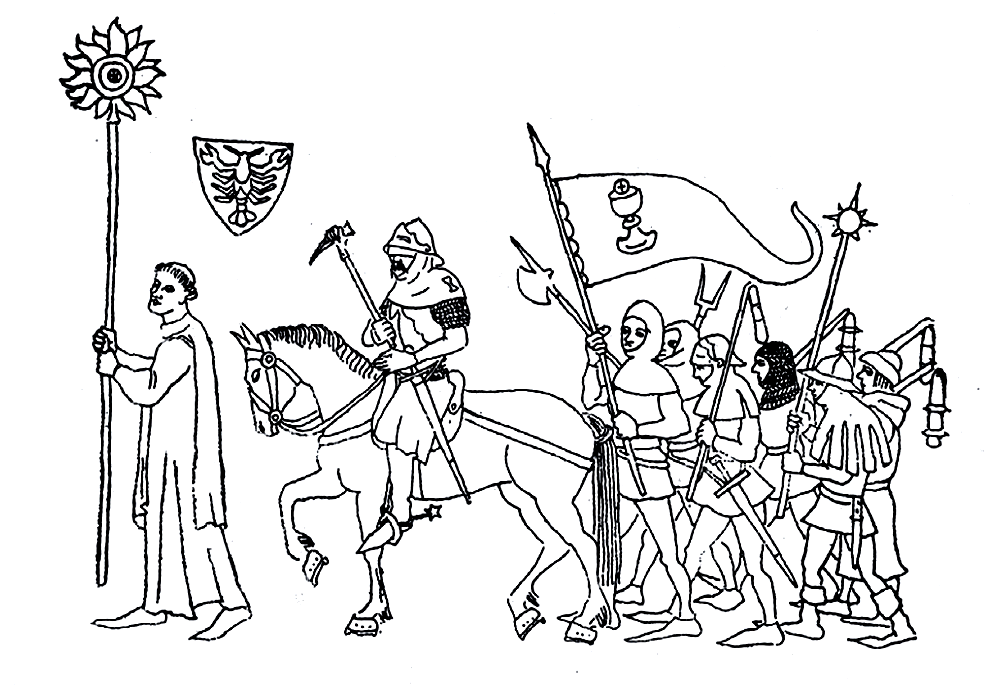
Contemporary depiction of the Hussites
From 1420 to 1432, Sigismund of Luxembourg and the German estates launched several crusades against the Hussites in the Kingdom of Bohemia. The latter reacted by attacking neighbouring countries. From 1428, several military campaigns took place on the territory of present-day Slovakia. They invaded the Považie region in 1431 in two waves: the first wave was led from Silesia through the Jablunkov pass by Jan Čapek of Sány; the second one set off from Uherský Brod with Prokop Holý at its head. They both came together near Žilina. In 1433, the Hussite armies attacked Kežmarok through Halič, from where they continued to Kremnica. From here, they journeyed back to Moravia via Žilina. The town and its surroundings once more suffered damage in 1434 as a result of the military campaign by the Russian Prince Fridrich of Ostroh, who joined the Hussites’s side. For example, a letter dated April 19th 1434 mentioned his stay in Žilina, in which the head of the counties of Máramaros and Spiš, Ján z Perína, called on the people of Kremnica to send military aid to the Liptov region, which Fridrich had set off for from Žilina. In a memorandum to the letter, Queen Barbara of Cilli thanked the people of Kremnica for taking part in the battles against the Hussites in Žilina. For example, a document from 1434 mentions the actions of the Hussites in the region of Strečno castle, in which King Sigismund ordered the castellan of Strečno not to demand higher taxes from the inhabitants of Teplička, Belá and Varín because they, too, had suffered great damage.

Prokop Holý
Anti-Habsburg uprisings
As a result of the social situation in Hungary, within the circles of the upper Hungarian aristocracy, an opposition was formed once more in 1666 with the objective of ridding the country of the Habsburgs. The main organiser of the conspiracy was the palatine Ferenc Wesselényi (František Vešeléni), with whom the Archbishop of Esztergom Juraj Lippay, the Ban of Croatia Peter Zrínski, the most influential magnate of the north-east of the country Francis I Rákóczy as well as the regional judge Franz Nádasdy also cooperated. The conspirators attempted to find support in France, Poland, Venice and Turkey, but did not succeed. The opposition movement was weakened by the death of the archbishop, and then of its main initiator, Ferenc Wesselényi. In the end, the conspiracy failed. The leaders were condemned to death. Despite the fact that Wesselényi’s son Ladislaus did not take part in the uprising, the king confiscated the property which he inherited on his father’s death; therefore, he lost Strečno castle. The special court in Bratislava, presided by Ján Rottal, judged over 200 nobles. Most of them were given long prison terms, and the extensive confiscations were intended to weaken the power of the resistance aristocracy.
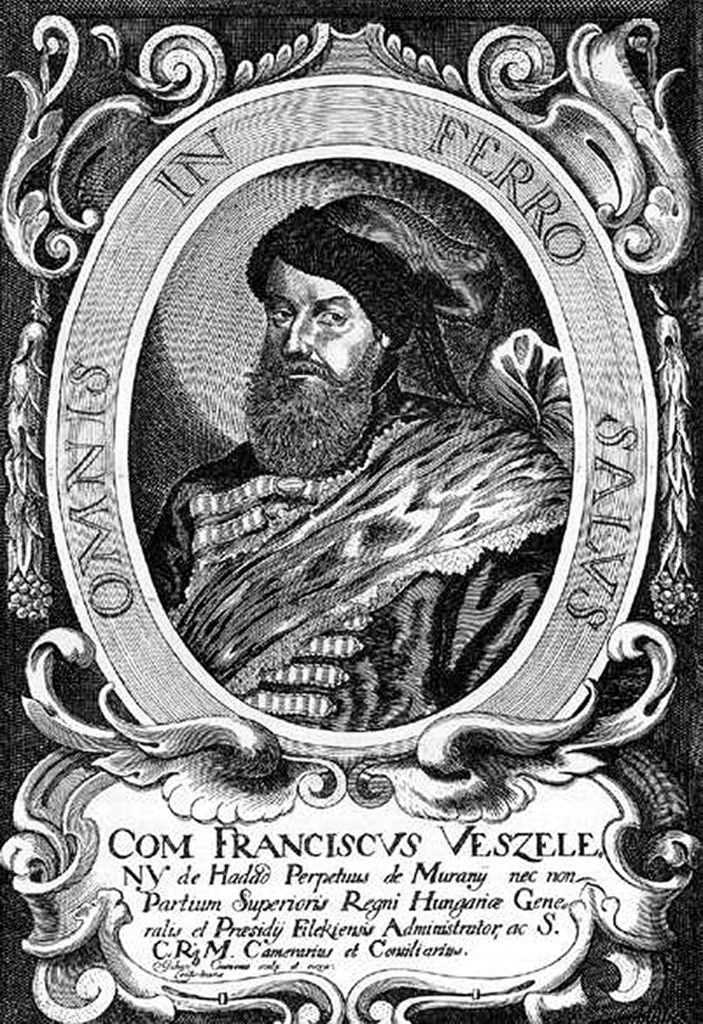
Portrait of F. Wesselényi
Many nobles fled out of fear to Transylvania. They were joined by soldiers who had been released from service in border forts. This group of fugitives/refugees, who had joined together to form larger divisions and were going on military raids into eastern and central Slovakia from the Postisie region and the mountainous areas of north-eastern Transylvania, were given the name of kuruci. For their opponents – the imperial soldiers – the derogatory nickname of labanci was used. The kuruc movement grew in strength partially thanks to the decision by the French king Louis XIV to provide financial support to the growing anti-Habsburg movement in Hungary in order to weaken his main opponent, Emperor Leopold I.
Encouraged by their success, at the end of the summer in 1676, the kuruci launched a campaign in eastern and central Slovakia. The commander of one of the kuruc groups, Imrich Tököli, managed to take control of almost the whole of central Slovakia. His popularity grew, and in the end the kuruci elected him in 1680 as leader of their movement. In the course of his military campaigns, Strečno castle was occupied in 1678 and 1689. This was also related to the fact that it was the only castle with modern fortifications in the whole of the Upper Považie region. For this reason, Emperor Leopold I preferred to have it knocked down in 1698.

Imrich Tokoli